

Trust does not look the same in every culture. CQ helps leaders read the signals before they misread silence, speed, hierarchy, or disagreement.
Trust is not universal in how it looks, sounds, or moves. Cultural Intelligence helps leaders build trust in global teams by reading context before judging intent. It gives leaders a practical way to understand how people signal credibility, safety, disagreement, and commitment across cultures, so the work can move without forcing everyone into one cultural operating system.
When I was in Malaysia, I kept seeing Grab, a delivery app, everywhere: jackets, helmets, bikes, scooters, e-scooters, the whole street moving in flashes of green. The lesson was not that Uber, their Western competitor, lacked technology. The lesson was that Grab understood the street. Grab built around scooters, payments, delivery, and the habits people already trusted. Trust was not created by saying, ‘We know better.’ It was created by reading the room before trying to lead it.
A quiet team member may be showing respect, not disengagement. A fast yes may be politeness, not alignment. A delayed decision may be a hierarchy at work, not a lack of urgency. In a global team, trust breaks when leaders confuse their own familiar signals with the truth of the room.
This is the trust-building layer of Cultural Intelligence in Action: the ability to slow down long enough to understand what people need before they can speak, decide, risk, and move together
Trust Breaks When Leaders Read Signals Too Quickly
Most leaders do not set out to mistrust their teams. The damage usually starts smaller than that. A leader reads a behaviour through the wrong frame, reacts to the wrong story, and slowly teaches the room what is safe to say.
If silence is read as disengagement, people who process carefully get overlooked. If direct disagreement is read as disrespect, honest debate gets punished. If indirect communication is read as weakness, the leader may miss the person who is protecting the relationship while still trying to surface the problem.
Trust is not just an emotion. It is a set of signals people use to decide whether they can be honest, take a risk, admit uncertainty, challenge a decision, or bring their full judgment into the room.
I learned that lesson the hard way in Bangladesh. My father sent me to place an order with an elder friend of his, a vendor who knew our family. I walked in thinking the respectful thing was to be efficient. He offered me tea. I said no. Coffee. No. Water. No. I placed the order quickly and left, proud of myself for not wasting his time.
Thirty days later, the shipment had not arrived. The problem was not the order. The problem was the relationship. He had wanted to sit with me first. I thought I was respecting his time. He thought I had refused the basic ritual of trust. In that moment, efficiency was not professionalism. It was a missed signal.
Cultural Intelligence matters because those signals are not the same everywhere.
| When a leader sees… | They may assume… | Cultural Intelligence asks… |
| Silence after a question | No one has anything to say | Is silence signalling respect, caution, processing, or disagreement? |
| Indirect feedback | The person is avoiding the issue | Is direct challenge culturally unsafe in this room? |
| A slow decision | The team lacks urgency | Is trust being built through hierarchy, consultation, or risk control? |
| Fast agreement | Everyone is aligned | Does yes mean agreement, politeness, or permission to continue? |
Why Global Teams Do Not Build Trust One Way
In some cultures, trust starts with competence. Do the work well, meet the deadline, know your role, and credibility grows. In other cultures, trust starts with relationship. Who are you? How do you show up? Do you understand the people before you push the work?
Neither approach is wrong. The mistake is assuming your version of trust is neutral.
A North American leader may think trust is built by moving quickly, naming the issue, and getting to action. Another team member may read that same speed as careless, transactional, or too blunt for the relationship to carry. One person thinks they are being efficient. Another wonders whether they are safe.
I see the same assumption gap in how organizations read newcomer talent. Someone may be unfamiliar with a laptop and get treated as if they do not understand technology. However, many newcomers come from mobile-first markets where people manage money, communication, payments, work, and family logistics from a phone with a level of fluency many Western workplaces underestimate.
Western workplaces are not just underestimating the individual talents of newcomers; they are missing the more efficient solutions these professionals may already know how to use. In Canada, legacy friction still shows up in hospital records moving by fax and banking systems that can feel slower than they should. Meanwhile, in India, someone can pay a utility bill, split a bill, or buy tea from a street vendor in seconds using a phone. When leaders can see that gap without dismissing it, they stop treating newcomer experience as something to correct and start seeing it as intelligence the organization can use.
That is where global teams get tangled. The breakdown is not always language. It is meaning. People use the same words – yes, soon, maybe, done, difficult, aligned – while carrying different expectations underneath them.
How Cultural Intelligence Turns Trust Into a Practice
Cultural Intelligence turns trust from a vague value into a leadership practice. It gives leaders a way to notice what is happening, test the assumptions underneath it, and adjust the conditions so people can contribute with more honesty and less self-protection.
The four CQ capabilities are especially useful because trust is not built by one behaviour. It is built through motivation, understanding, reflection, and adaptation working together.
| CQ capability | How it builds trust in global teams |
| CQ Drive | Keeps leaders curious when difference feels slow, uncomfortable, or inconvenient. |
| CQ Knowledge | Helps leaders understand how culture shapes authority, feedback, time, risk, and relationship. |
| CQ Strategy | Creates the pause before a leader reacts to the first story their mind writes. |
| CQ Action | Helps leaders adapt communication, pace, and process so trust has a chance to form. |
This is not about becoming endlessly flexible. Leaders still need standards, decisions, accountability, and momentum. Cultural Intelligence does not remove the hard parts of leadership. It helps leaders stop making the hard parts harder by misreading the people in front of them.
The goal is not to make every team member behave the same way. The goal is to create enough shared understanding that people can do serious work together without having to translate every signal alone.
The Trust Signals Leaders Should Watch For
Trust in global teams usually shows up through small patterns before it becomes a big problem. Leaders with Cultural Intelligence pay attention to the moments where meaning can split.
Watch who speaks first, who waits, who agrees in public but goes quiet afterward, who needs a one-on-one before they will challenge an idea, and who treats speed as confidence while someone else treats it as a warning sign.
These are not personality quirks to manage around. They are signals. They tell you how trust is being negotiated in the room.
| Trust signal | What to look for |
| Voice | Who speaks openly, who waits, and what conditions change that pattern? |
| Speed | Does speed build confidence, or does it make people feel pushed past context? |
| Risk | Who is comfortable naming uncertainty, and who needs more safety first? |
| Authority | Do people challenge the leader directly, privately, indirectly, or not at all? |
| Follow-through | Do commitments mean action, alignment, politeness, or more internal checking? |
A Simple CQ Practice: Signal, Context, Commitment
A practical way to build trust across cultures is to borrow from Cultural Intelligence CQ® and slow the moment down through three questions: Signal, Context, Commitment.
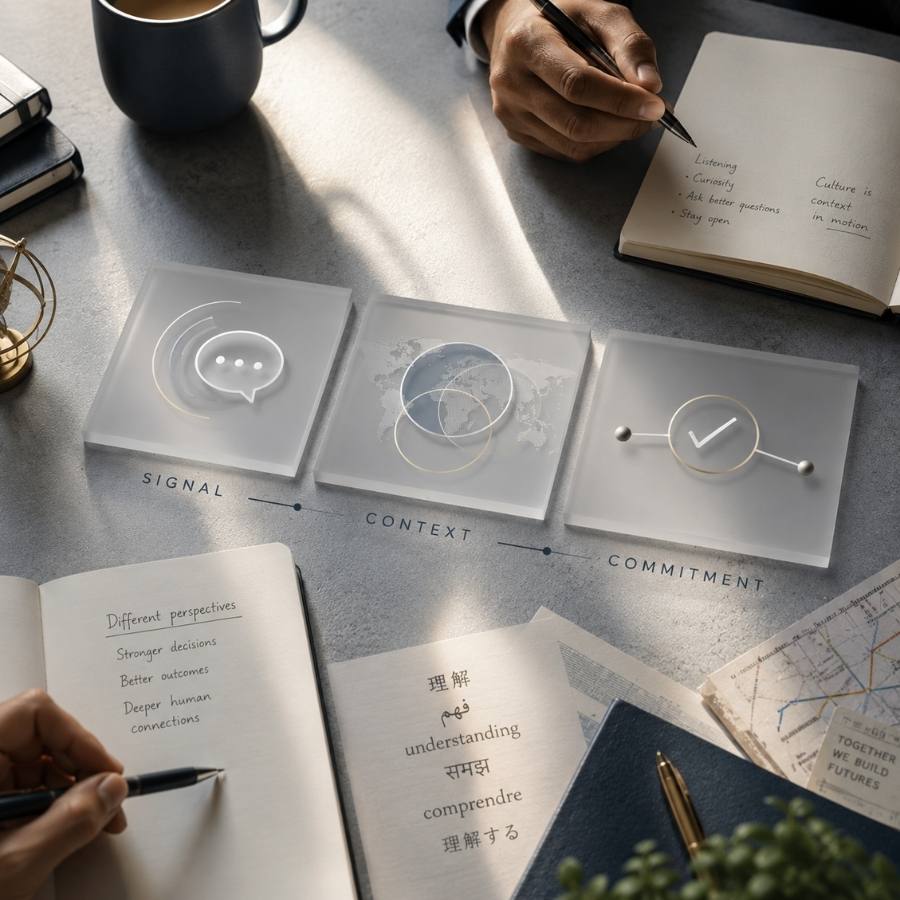
Signal: What did I actually observe?
Context: What cultural, organizational, or personal pattern could be shaping this behaviour?
Commitment: What small next agreement would make trust more visible?
These questions are simple, but they change the room because they slow the first reaction. Early in my overseas work, I remember trying to speak with a gentleman in South Asia face to face. Every time I shifted to square up with him, he shifted away. I moved again. He moved again. It became this strange little dance in circles.
I later understood that direct face-to-face positioning was not the respectful path in that context. Standing to the side, or side by side, made the conversation feel less confrontational and more human. The signal I was reading as distance was actually respect. Without the pause, I would have judged the wrong thing.
That last question matters. Trust in global teams is often built through visible commitments: who will decide, by when, through what process, with what room for questions or dissent. When the process is unclear, people fill the silence with their own cultural assumptions.
A leader does not need to solve every difference in the room. They need to make the next step clear enough that people can move without pretending they understood more than they did.
How EIA Builds Trust Before Action
My EIA Method – Embed, Interpret, Act – applies the same trust discipline at the strategy level.
Embed means entering the environment before imposing your own operating map. Interpret means making sense of the signals, including the ones that do not look familiar. Act means moving in a way that fits the people, place, and moment.
That sequence builds trust because it resists the leadership reflex to act first and understand later. Many global teams do not lose trust because the strategy is weak. They lose trust because people feel interpreted too quickly, consulted too late, or asked to execute a decision that never fully understood the room.
The Grab example is EIA in motion. Embed: understand how people actually move through the city. Interpret: recognize that scooters, local payment behaviour, and street-level habits are not side details, they are the operating system. Act: build the service around what the market already trusts.
Cultural Intelligence gives leaders the working muscle. EIA gives them the operating sequence.
Cultural Intelligence Builds Trust, Signal by Signal
Cultural Intelligence builds trust in global teams by helping leaders read context before they judge intent. It makes the invisible signals of trust more visible: silence, speed, hierarchy, disagreement, risk, and follow-through. When leaders learn to pause, test assumptions, and adapt with clarity, teams do not need to choose between honesty and harmony. They can build the conditions for both. Trust is not automatic because a team is diverse or global. It is built, signal by signal, by leaders who know how to read the room they are actually in.
Work with Muraly. Culture is strategy. Muraly Srinarayanathas speaks on Cultural Intelligence as a business advantage, the EIA Method for global expansion, and building high-performing global teams.
FAQ
Cultural Intelligence builds trust by helping leaders understand how people signal safety, credibility, disagreement, and commitment across cultures. It helps leaders test assumptions before reacting to behaviour they may be misreading.
Trust is different in global teams because people may read authority, time, feedback, silence, speed, and relationship through different cultural frames. What feels direct to one person may feel unsafe to another.
Trust often breaks when leaders interpret unfamiliar behaviour through a familiar frame. Silence becomes disengagement, indirect feedback becomes avoidance, and delayed decisions become lack of urgency, even when something else may be happening.
CQ Strategy helps leaders pause before acting. It is the discipline of asking what they know, what they are assuming, and what else could be true before they decide how to respond.